Showing posts with label theology. Show all posts

Sunday, March 19, 2017

Guilt for the unsaved, Sunday meanderings


I have seen people cry because their relatives and close friends do not belong to the same denomination or religion they belong to. 

They feel guilty because they have genuine love for their loved ones and it's really unthinkable to live in paradise while your children, or spouse , or friends are in hell in eternal torture from burning and swimming in sulfuric lava.

There also those who are concerned about their accountability because in the end, when things have come to its realization, they could be held liable for not sharing or convincing people around them to convert to their religion. Of course, the guilt is based on the premise that the only true religion, the only true church is the one that they belong to. 

It's futile to argue about the validity of this claim to exclusivity because almost all of the religion have an exclusivity clause. I am not thinking about Christianity and its thousand of sub-denominations that have their own exclusivity clauses, I'm talking about religions in general. I respect Holy Books but to talk about things, argues, explore reality, within the confine of the pages of these Holy Books is very restrictive and problematic, for me.  There will be no conversation but a one way spoon feeding of doctrines and dogmas.

Think about circumstances, forget yourself for once and pretend that you're someone else who is born in another country, grew up in another culture and belongs to another religion. Let's pretend that you're an average Filipino citizen, born in a Christian culture. You go to church regularly, you work honestly, and you live an average life like an average Filipino. 


Then a Muslim missionary knocked at your door and offered you Islam as the way to your soul's salvation and that Christianity is a false religion, Satan's creation to challenge the real and true religion. (Islam is the fastest growing religion today.) He is offering you a new way of life of devotion to Allah. You may raise your eyebrow because you grew up in a Christian community and is a practicing Christian and your perspective of things is very Christian. 

Christianity (and the church you belong to) is the only true church or true path to salvation because that's what is inculcated in you by your culture, your community, your family, your government and by social genetics. Your whole being is immersed in Christianity and to think apart from this perspective is (almost) incomprehensible, even unthinkable.

And you may be surprised that there are Islamic missionaries because you think Muslims proselytize by the sword or violence.  Your first reaction is hostile. You're instinct is to run or to pray out loud to invoke the power of the Holy Spirit to repel these enemies of the church. But then common sense and education got the better of you and you declined politely.

Of course chances are you will not take  these Muslim missionaries seriously and may even look at the them with suspicion and disdain. But when these missionaries start to open up with their goods and aids, doors would open.

Anyway, this is hypothetical but these missionary thing happen all the time. i think it's only the Buddhist who give shelp without attaching their religion to their charitable works. 

Millions of people who are born in different country, in different cultural setting, in different religious traditions, and in different circumstances in life. To think that God revealed himself to a particular race and that this particular revelation is the only true revelation and is the only true way to salvation (whatever that may mean but I am not inclined to think that souls are meant to walk on gold pavements and sing praises to God in eternity), I think misses the goodness in other people. (the inclusive may say, "Hey we see truth in their beliefs, it's juts that their's is not good enough, they fall short!"

I was reminded of a scene from the novel "To kill a mocking bird" where a white american drunk bum beleived himself to superior to a hard working black american because of his skin color. 

Sunday, March 05, 2017

Meanderings on Religious Exclusivity


Put plainly, religious exclusivity is the belief that my religion is the only true religion and the others are bullshits. (Bullshit is a PC word compared to what preachers say about people who do not belong to their religions and the traditional nomenclatures they use ranges from infidels, condemned, pagan, unsaved, children of Satan, demons, witches, etc. :Bullshit" is way, way kinder than these terms and to think that some religions even behead people who do not subscribe to their beliefs. Definitely, bullshit is much better) . 

Another dogma of religious exclusivity is the conviction that only those who belong to my religion would go to paradise. Well, to tell the truth, not even all those who are in my religion would go to paradise because there's a selection process that the believers must go through like indoctrination, infant circumcision, prayers, pilgrimage, holy wars, etc. Even those who have participated and met these requisites do not automatically become saved, there is the other part, the inner conversion, the miraculous transformation of the believer, the spiritual thingy.

Now, if one sits down and give enough time and coffee  to think about it, it is obvious that religious exclusivity is one of the the roots of all evil. I would not even dare say it is religion because there are religions that would not even hurt an insect! 

Open your history books and you'll read that most of the man-made miseries in the world is caused by the idea of religious exclusivity. Even today, watching the current event in the Middles East I am inclined to think that this area of the world is in the dark age because the region is divided into religious factions each killing one another primarily because of the differences in the interpretation of their holy book and secondly because the schisms are being taken advantaged of by the Western primarily Christian part of the world to advance their interests. 

These fanatics that came from the same religious gene cannot coexist with one another because of the effing idea that heaven is reserved to the few. Pity the innocent and the decent people who simply want to live in peace but no, they must be converted.


The idea of exclusivity goes back to the primordial soup and the microbes. Microbes based their survival in one scientific principle of physics and that is "no two objects can occupy the same space at the same time". 

So, what the microbes do is multiply fast and produce enzyme or whatever you call these stuff they produce to displace another group of microbes. they congregate and those who are not within their congregation are displaced and then exterminated.

Exclusivity is a survival mechanism. It is built in to every living things' DNA from the microbes to Bill Gates. Animals form packs, herds, schools etc, to protect themselves from their predators and also these animal group protects themselves from their own kind in their struggle for food and territory. People are not that different, though we have evolved and transcended the animals' feral struggle for survival, yet exclusivity is still humanity's primary motivation for the struggle against each other though unlike the animals, people tend to cling to exclusivity more out of greed and not of need.

Socially, for us exclusivity is primarily genetics. We form group from families, to clans, to tribes, to nation from which sprung up belief system. Religion is nothing but an extension of the clan, the social family. 

One current proof of exclusivity  is what Trump is doing now.

It is understandable now why this idea is easily translatable into the beliefs or faiths. Religious exclusivity especially among the Abrahamic religion is primarily a survival mechanism which in the process of historical evolution has become the mechanism for oppression and control especially among its fundamentalist and fanatical adherents.


Monday, January 30, 2017

What is the mark of the beast? Is it 666, or 777, or SSS? What numeric symbols will Satan use, Hindu-Arabic? Jewish? Greek? Chinese?

One thing that makes my head paused and then grind is when I hear a preacher talk about numbers. There’s the fear that the social security number, credit card number, the HUMID card, etc. are omens of the end of days and that these numbers are evil because it portends the arrival of the beast. In the preacher's belief, these numbers are the precursor to the mark of the beast, the dreaded 666.

The dreaded mark

Try as hard as I can to switch off my critical thinking head (or Satan’s voice) I cannot help but think.

Christianity has its own numerology, the belief that numbers have mystical relationship with the divine. 

There are a lot of numbers mentioned in the Bible and some of them are:


3 for resurrection, trinity
4 for the four corners of the earth
6 for imperfection
7 for the seven days of creation/perfection.
12 for the twelve tribes
40 for the forty days after Jesus rose from the dead
And so on.

These numbers have been studied, decoded and interpreted by laymen and scholars of all  ages and theological persuasions. Because these numbers have been granted mystical and spiritual meanings, not by the Scripture itself but by the interpreters and the mystics, it sprouted mysticism and superstitions. But I would leave it at that. If you’re interested about what these numbers mean and the mysteries behind them, try Wikipedia for a start. I will not dwell on the numerology, instead I will ask some basic linguistic questions especially about the mark of the beast, the dreaded 666.

First is it the number, the literal figure or the concept behind the number that really matters.

Numbers are symbols which in themselves are meaningless. Think of it as a currency or money that we use to exchange ideas instead of merchandise. Whatever the origins of these symbols are doesn’t really matter in the discussion, but the fact is that they exist and they are part of our language and for each symbols, through social agreement or laws, etc. are assigned values. So, like currencies, its value is limited to those who are participants in these agreement of value assignments and naturally, like currencies, these numerical symbols have no meaning to the people who does not recognize or assign value to these figures, they are not participant to the language game (Wittgenstein).

1. In what language was the Bible written?

The Old Testament is written in Hebrew. So, what are the numerical symbols in Hebrew?


Let us see the chart below:


Supposed Satan and his cohorts arrived and started stamping people with the figures resembling that of 777, which is really 666 in Hebrew, the language the OT was written, which on the other hand corresponds to the number of perfection in our modern numeric system as written in the English Bibles. How should the common non-Hebrew literate Christians respond? I mean, I hope they would not line up to be marked because they have been told that 7 is God’s number!

Of course, since the Bible is pretty old, these numeric symbols maybe different from the chart, it could be similar to number 4, who cares, but the idea is there. Is it about the actual number or is it the concept, the idea behind it?

Lets try the Greek, the language of the New Testament.


According to the Greek chart, the equivalent of the Hindu-Arabic 6 is similar to our “s”. So, when the beast and his cohorts arrives and started stamping people with SSS or what looks like it, what should be the response since it is really 666 but the Beast ,because he’s Satan and he's smart and found a way to get around the number rules, used the Greek numeric symbol to dupe Christians into being stamped because they have been brainwashed to fear the Hindu-Arabic  number 666.

The argument could go on using the same line of reasoning, should the Chinese watch out for 666 or Chinese characters corresponding to the number 666, the Japanese, Koreans, Thais, and other people that do not use the English alphabet and the Hindu-Arabi numeral system.

Of course, it could be argued that since the Hindu-Arabic is what is commonly used in the world especially in transactions, it is only logical that 666 would be used. But then this proves that it is not the literal symbol, number, that really counts, because the original number is written in Hebrew or Greek or Aramaic which is translated into the Hindu-Arabic characters, then it is all about the idea behind the number. I mean, I could go on…but do the math.

Of course there's a real, factual, historical explanation for the number 666. Well, you dont have to go to the library and take out a tome about it, just google it.

Now, am I the only who have asked these questions. I supposed not...But personally, whether it is 666, 777, 888, 999...doesn't matter personally to me. Evil is not as mysterious as some would have it, evil  does not have the need for mystery. It is out there in the glaring light of daylight and the dark of night, identifiable by the naked eye and by the blind, slavery, war, poverty, apathy, religious fanaticism, bigotry, etc.


Wednesday, September 14, 2016

Coffee-rnican revolution in religion and why too much coffee drives me nuts

Okay, it must be the three cups of coffee I drunk this afternoon. Classes were suspended, it was raining hard and the temperature dropped, coffee was irresistible. The caffeine is still running around my head.


I have read John Hick's God and the Universe of Faiths

I have been thinking about what's in the book since I dabbled into theology, which I was never good at  by the way, a couple of years back. 

One of the things that I find difficult to wrap my head around about religion is the idea of exclusivity. Exclusivity is the claim that one's faith is the only true faith and all the other religions are false, that they need proselytizing and at it's worst enemies to be overcome or conquered.

Exclusivity is a mechanism used by a group of people, family or tribe or nation to preserve its cultural identity. This idea is associated with a local god or a tribal god. A good example of this are the Jews. By maintaining a unique relationship with their tribal god, they have fought off foreign influences.  They formulated codes and laws that encompasses the whole aspect of their identity. And these laws are written by their god himself and this made their laws inseparable from their god. 

With the destruction of Israel, the Jews were dispersed. They were scattered among the neighboring kingdoms but despite the dispersion, they have kept their identity. They have accomplished this through strict and rigid adherence to their laws and traditions. The Jews also forbade intermarriages. Adultery both religious and interracial marriages are dealt with harshly by banishment and even death. This preserved not only their culture and faith but it also assured the genetic conservation of the race. 

Their identity is inseparable and indistinguishable from their god: their religion is their citizenship.

Then came Jesus. Jesus was a Jew, a Jewish heretic. He professed to be the messiah introduced a new and improved version of Judaism which the old school rejected. he was crucified by the Romans with the instigation of the Jews.

A few hundred years later, Paul discovered Jesus and became the missionary that spread Christianity. Christianity is basically a Judaic religion,hence the idea of exclusivity, though expanded to include non-Jews, is still  at it's core. This exclusivity, like the Jews, assured its survival, But unlike the Jews, the laws and traditions, which was repudiated by the new testament, was too porous, hence pagan (which means non-Christian religions then) slowly seeped into the new religion hence many non-Christian doctrines were assimilated into it. 

The reformation came. 

The reformers broke away from the Roman Church which they deemed was corrupted by pagan and mystic philosophical thoughts. So, the Roman Catholic Church has stopped to be the only vehicle towards salvation. She is not the bride anymore.

The church split and with each split came the idea of exclusivity, with each schism and division, exclusivity becomes narrower and narrower that even among denominations there those who consider their brethren church not pure enough to be included among the elect.

Of course, in the book, John Hicks' discussed the relationships of Christianity with other world religions but it need not go far because within the Christian faith exclusivity is claimed by each denominations, though evangelicalism is a movement that seemed to be moving towards inclusion but in general it still a strict exclusivist because of their doctrine that only Jesus saves.

Exclusivity promotes the idea that the religion or the church one belongs to or born into is the only real church or religion  and this ecclesiocentricism denies the truths or only recognizes partial truths from other religions and treats them as inferior, even enemies. This is analogous to Ptolemy's idea that the earth was the center of the universe. The church becomes the earth in Ptolemaic universe and other faiths or denominations are revolving around that specific church.

The Ptolemaic view of religion, according to John Hicks must give way to the Copernican revolution. Instead of a religion or a church being at the center of the religious universe, it should be theocentric, God should be placed at the center where religions revolves around it.

This solves the a lot of problem from revelation to salvation. 

Anyway, I'm tired. Read the book or wait till I get into the mood and talk about Hick' ideas.

This post sucks.


Sunday, September 04, 2016

Dark clouds: I was expecting the Biblical Armageddon and Independence Day to happen


Sunday. 

Went to church in a good mood which I think was due to the good weather. I was listening to the sermon when all of a sudden strong cold wind blew through the church's window and temperature dropped which made me shivered.  

Looking out through the windows, I saw dark clouds merging into one pregnant super cumulunimbus cloud. My imagination was running wild. I was expecting the four horsemen to emerge racing through the clouds charging with their weapons raised above their heads ready to harvest the unsaved while the heavenly hosts' trumpet corps played the Battle Hymn of the Republic. Armageddon was coming upon us but I was sure that I would be spared because I am one of the elect, that's idea of belonging in a church, by the way. 

But it was just a burst of rainstorm. Maybe next time.


I didn't mean to be irreverent but I had no control over the visualization. Anyway, alien invasion did not kicked in. I guess the...never mind.

There were two things that kept me awake and praying at night when I was little. One was the rapture. I had nightmares about being left behind after the Almighty, in a blink of an eye, teleported all the elect into heaven leaving the dammed to be marked by the beast or, to get another chance to be saved,  by dying in defiance of the anti-Christ. 

This fear was reinforced by rapture and hell movies used by American missionaries to scare the hell out of Filipinos into accepting Jesus as their savior. 

But after the doctrine of assurance calmed my fear of rapture, I was struck by another phobia: fear of alien invasion. 

Thanks to TV series like Space 1999, Battlestar Galactica, Twiligh Zone, Buck Rogers, I spent many nights looking out our window expecting lights to come down from heaven and little green men or metallic centurion to come charging and rounding up people in the neighborhood. 

The idea of being hit by a disintegration laser beam or being host to alien spores gave me nightmares. I guess the images from movies and TV drove my imagination into hyperdrive. 

I think that's one reasons why my notebooks were full of intergalactic battle drawings. I remember my grade three teacher checking my notebook and making a face at the saucers and space battleships exchanging cosmic rays and missiles. But ironically, I see the same drawings from some of my pupils now.

I grew up and with it the fear just went away. That's why I find it hard to relate to religion that preach fear in order to entice or to coerce people into accepting their doctrine or their church. 

They paint this bleak picture of humanity, of life, their insistence on the reward of eternal life and the picture they paint reflected the worldview of their holy books writers' age.  


Well, anyway, same old, same old...How I wished I was a gullible child again.

Friday, November 13, 2015

Should Christian students stop studying philosophy and literature? A meandering into the irrational fear of philosophy and literature


I have been thinking a lot...

Well, when its painful to stand up and all I do is sit in front of the computer, there's no choice but to think and to keep my mind off my excruciatingly painful ankle and knee, gout. 

I guess that's why many famous philosophers are either too rich to care about money and the daily grind, or are too poor , eccentric and unmarried to care about anything except thinking of and thinking up crazy stuffs.
Diogenes. He proved that anyone could be
poor, crazy, wise, an a-hole and be
intellectually  intimidating at the same time.
Legends has it that he scolded
Alexander the Great for disturbing his sun bathing.


Anyway, I have always been bothered by preachers on TV and behind the pulpit who say that philosophy is bad. Sermonizing about its evil and discouraging students who are into it as a part of college course. There are even preachers who discouraged reading literature! Whenever I hear this phobic vituperations against philosophy and literature hurled from the pulpit by a preacher, I guess being a teacher, I have this urge to stand up and throw a tome to the preacher's direction (maybe the head) and tell him,: " what do you want us do? Go back to the stone age!".

I am not a student of philosophy. My dose of philosophy was the prerequisite philo I and philo II in college which i heard was already taken off the first year and second year college curriculum for education students.


Nietzsche. Just a mere mention of this
guys name sends shivers down many
pastors asses. Why? Because he made
famous the slogan "God is dead." Which
many Christians believed was the
ultimate blasphemy, a judgment made without
 having read and analyzed some of his books.
Actually, he also killed God but this
death of god is not like stabbing a person
 with a knife and taking his life which
many preachers would like the 
congregation to believe is what this
guy meant. What he meant and what is
actually a reality now is that god has become
irrelevant. Doubtful?
May I ask how many Christians still 
believe that if you curse the name of God
you'll die in your place. 
All I could boast was that I read some stuff about it especially the Greeks because these pioneers were the most accessible read. The only modern philosopher that I could say I read and understood (maybe the more appropriate word is "felt") was Nietzsche and this was because he wrote in bursts of colorful language using lively meter. His writing could shock anyone specially to the first time readers. His attack on Christianity was distilled from his experience with the hypocrisy of Christianity's actions in the background of the political situations of his era that gave birth to his philosophical nihilism (again, he hates Christianity and the clergy, ministers and pastors but he had an affection for Jesus, at least not the same hatred for the clergy). Also, his father was a minister. guess he experienced Christian hypocrisy in the first person. he was not mad, he died mad because he got syphilis.

I tried reading Kant but it's like chewing concrete blocks.

But if there's one thing that endeared philosophy to me, it is inquiry. It's the activity. it's the way philosophy can empower an individual to pursue an idea or anything using pure reason.

Religion has always been hostile to inquiry even internal ones that would challenge the existing status quo, not to mention the tortures and persecutions. It's not because they were afraid of the changes that may come from new ideas or discoveries, it's because the religious feel, which was rightly so, that their authority and hold on the people would be compromised because their power and authority was primarily based on the perceived divinity of their books, hierarchy and lineage and secondly this hold was empowered by the ignorance and the lack of imagination  of the people. They tried to stop the enlightenment but failed. Today, the religious has to take a different tack to spread their religion. They cannot rely on their perceived "holiness" theological dogmas, moral superiority and metaphysics to lure people back to their fold, now they have to engage them in decent intellectual conversations, prove that their religion is relevant to today's settings. 

knowledge is power!

Many preachers love to quote St. Paul in Colossians ‘Beware lest any man spoil you through philosophy and vain deceit’ (Col.2:8). What was Paul talking about here? just like today, in St. Paul's time, philosophy could mean a lot of thing. It could mean a specific philosophy like stoicism, epicureanism which Paul had some dealings with. Or it could also mean religions, which in this verse is the case."See to it that no one takes you captive through hollow and deceptive philosophy, which depends on human tradition and the elemental spiritual forces of this world rather than on Christ."


knowledge power! Pinoy version.
This guy knows a lot of stuffs.
He had a lot of herbal formulas
for longevity and preventing diseases.
Ironically, he died of heart attack
atthe age of 56.
Philosophy even the ancient Greeks have very little room for spirits and traditions. This verse is a general warning for anyone not to be hooked on anything that challenges Christ. 

The New Testament was written in Greek, immersed in Greek culture and though many denied but a lot of terminologies and concepts used by Paul in his letters were from Greek philosophies. It's wishful thinking to say that the new testament was written devoid of any Greek philosophical influence.

Many religious will disagree but it is undeniable that most of the language used in the formulations of highly abstract Christian doctrines borrowed a lot from Greek philosophy. Ironic.

(My ankle and knee is killing me.) 


Thursday, April 02, 2015

Lent: Healing, Spirits,Amulets and the weirdness of it all...

I was watching TV. 


Well, I was watching TV passively since I was engaged on the computer FB-ing, surfing and looking at some bonsai pictures for ideas on how to developed my bonsai materials when my attention was caught by a TV news feature about a man who allegedly can heal people's sickness through the power of a spirit that possessed him.

This has started a series of crazy thoughts.

Of course the Church is quick to announce a caveat about the phenomenon saying that people should be careful about the healing and they should discern whether the spirit is from God or from the enemy, Satan (by the way "Satan" means the enemy).


Holy week is a special day for spiritist/faith healers in the Philippines. Good Friday and Black Saturday is the most potent day for their rituals and prayers. They believe that they have access to powers and spirits in the belief that God is dead during this period. 

As to they do prayers and rituals during periods when they believe that God is dead is itself a telltale sign that they are dealing with different spirits other than the Christian Holy Spirit.

This belief in the multitudes of spirits is inherent among the Filipinos who were originally animists; they believed in multitudes and hierarchy of nature spirits. This animistic worldview has changed very little even with the introduction of Christianity to the islands in the 1500's. 


Many Christian traditions and holidays are infused with indigenous animistic elements while many indigenous animistic beliefs are infused with Christian elements hence there is no polarization between two different world views. in fact they co-exist harmoniously in the Filipino's belief system. Instead of delivering the Filipinos from animism and converting them into Christianity, what resulted was the fusion of both faiths into one belief system that resulted in Folk Christianity, which is very different from the theological and philosophical Christianity of the west.

But what do I have to say about this?

Well, this primitive belief in the spirits and amulets only show the psychology behind it: primitive, unschooled, heretical...etc. No one should believe that there are power in amulets, incantations, trees, spirits, ghosts, mountains. Hell, all these beliefs are alike to believing in Santa Claus, St. Valentines, The Greek Mythology...

The true faith is this: God, the father in Heaven, created humanity. But humanity sinned against God, the father. God the father loves humanity so much that he gave his Spirit, who is God the father himself but not God the father himself, to a virgin woman so that he could go down on earth as a man, God the son himself but also God the father but different from God the son but the same as God the Father but different: God the Father is God the son Himself but they are two but one.  To offer his death as a propitiation to God the Father, who is God the son himself, for humanity's sin and transgression against  God, who is himself  God the son, so that humanity will be saved from the punishment of God the father, who is also God the son. 

Hmmm. Theology sucks.

On second thought...the weirdness of it all. Santa Claus seems more comprehensible. Anyway, we are just human beings seeking trying to understand powers and realities that are beyond us. 

So...let's eat.


Wednesday, April 01, 2015

Lent meanderings etc.

Photo not mine: torture porn?
I heard snare drums and shouts. I looked out and saw a group of children and teenagers dressed in first century Roman and Jewish clothing re-enacting passion of the Christ through our narrow eskenitas.

This is a yearly tradition that I used to join when I was a child, when were still Roman Catholics. But now that our family has been converted to the Southern Baptist tradition, we now believed that the humiliation and the sufferings that Jesus Christ went through was a one time event that happened tow thousand years ago and was meant to give saving grace to humanity: Christ has done it so that anyone would not have to go through the sacrifice again and again.


Old ladies singing the pasyon the traditional way.
Being a Baptist, there's this negative attitude towards how Filipinos observe lent: the pabasa, prusisyon, penitensya, bisita iglesya etc. I believe,as taught by pastors, that all these activities and traditions were unbiblical and hence are un-Christian. But as the Catholics would argue, the Roman Catholic Church has existed for almost four hundred years without the Bible (as we know it now) and has done well using traditions as its guide, which is really a good argument for their doctrine that tradition is an equal authority along with the Bible on church matters.

I cannot imagine lent without the pabasa and the senakulo. The pabasa is getting rarer now, at least in our neighborhood. I missed the off key and and atonal harmonization singing of the passion of the Christ. Lately, they have been adapting modern tunes though there's nothing wrong with it and it is even encouraged by some to promote the pabasa to the younger generations, I missed the old tunes and the vibrato that goes along with the singing.

Thursday, October 04, 2012

Monotheistic polytheism


I have been thinking about God. Being a personal God, that we could relate to literally it is then safe to say that believers have different and may I say individualistic conception and understanding of God that depends upon the individual's need. There this psychological vacuum and this vacuum shapes or influence the conception of God. This is undeniable. The idea of God during childhood is different from that of adolescence, adulthood and old age. Each stage has its own development of the understanding of God and though they may be called developmental, but there is also that element of  conceptualization involved with it--creating personal ideas of God, I suppose it could be called revelation.


What I imagine this to be is that each individual have this doctrinal understanding of God as taught be religious teachers that becomes the framework or the skeleton for the developing idea of God. 

On the theological level we have the doctrine of God's omnipotence, omnipresence, omniscience, perfection, uniqueness, immutability, transcendence, immanence and all that stuff and fancy words that no ordinary folks ever think about or may not even attempt to understand.  

There's the moral or ethical side of God being good, hates evil, punishes sinners by sending their souls to hell and rewarding the believers by sending their souls into heaven and that good and bad stuff that goes with ethics. 

There's the mythological and anthromorphical side to God like the talking bush (I think 'botanical' is more apt), the story of Noah, Jonah etc. The virgin birth, resurrection, etc. 

There's the historical controversies that killed a lot of people like the trinity (this is not a clear doctrine since this is not clearly taught in the scriptures), the hypostatic-union of the natures of Christ (again, the teachings are implied but not directly taught and I sometimes wonder if the first Christians even thought about these things); the war on the interpretation of the word "body and blood" in the Lord's Supper that also almost split a nation; baptism, clerics, church organization,...etc.

Then there's relational side of God, the master and servant, potter and the pot, father and son (and daughter, may I add). All these things (hmmm...did I forget something?) Ohh, I forgot the prophetic or the eschatogical things but, as complicated as things are already...let's just, let's leave the second coming and the end of the world alone fr the meantime.

As these characteristics or picture of God or idea of God are slowly assimilated in our mind, the idea then becomes too bulky and heavy and I don't think ordinary Christians even knew or bother to think about these stuffs, which, may i say, is very, very understandable.

Clearly many or most philosophers and scientists (may I add theologians who may like to play in theological arena but personally...I mean what can I say to a theologian who thinks of God as the ground of all being but that his foundations are shaken...)  could not accept such a personal being for a God. Which quite understandable because it smacks of polytheism.

Polytheism? yes, this is what I think it is. There's this two level of the understanding of God.


First is what is taught about God by the revelation of scriptures, whatever the scriptures maybe. God is presented together with his characteristics as defined by inspired revelation or the scriptures (or holy books). So, this is the superficial picture of God; the doctrines, the creeds, dogmas, etc. which gives an illusion of uniformity. I call it an illusion of uniformity because, like I said before, these theological concepts are too abstract for the common folks and that's why symbols are used to represent these concepts, but the oversimplification created by the use of symbols created more problems for the church, like the adoration of idols and icons.

The first layer, unfortunately, is superficial and may I add, resides in the cognitive faculty of the mind. This knowledge of God is what gives this idea of  unity or the idea of monotheism--that is worshiping one true God. well, this could be true at this level. 

The idea of a personal God is what gives me some discomfort because in espousing this idea that one an relate to God like relating to a father or a friend etc.somehow creates this secondary understanding of God to which most of the times is a self-ish conception of God. This has become a challenge because the unity or uniformity of God is also being diluted (or even polluted) by the diverse way in which God is being understood and related to.

So, there's this second level of grasping God and at this level, the identity of God is somewhat dissolved in the psychological...hmmm. At this level, we each have our own God--uniform at the top but diverse, different and unique at the personal level.

Of course one could argue that, like in a family, the chidlren have different idea about their father but this does not make the father different for each children. But then again...this analogy is inadequate because fathers are physical beings.

(Why o why do I even think about these things!)

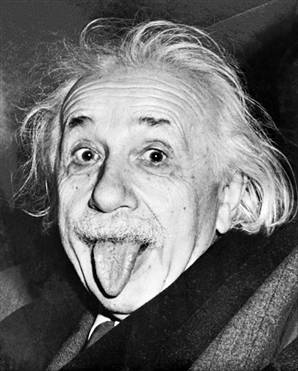
Einstein, God, blah, blah...


I was oft amused whenever I see quotations supposedly made by Einstein about God with the idea or intent that Einstein believed in God, as I would supposed, the Christians conceived God to be. This is kinda weird because Einstein and other thinkers for that matter, who we may assume(d) to profess belief in God do not really believe in the personal God in the tradition of the Judeo-Christian faith.  

The man who is thoroughly convinced of of the universal operation of the law of causation cannot for a moment entertain the idea of a being who interferes in the course of natural events--provided, of course, that he takes the hypothesis of causality seriously. He has no use for the religion of fear and equally little for social or moral religion. A God who rewards and punishes is inconceivable to him for the simple reason that man's action is determined by necessity, external and internal, so that in God's eyes he cannot be responsible, anymore than an inanimate object is responsible for the motion it undergoes. Science has therefore been charged with undermining morality, but the charge is unjust. A man's ethical behaviors should be based effectually on sympathy, education, and social ties and needs; no religious basis is necessary. Man would indeed be in a poor way if he had to be restrained by fear of punishment and hope of reward after death.

The main source of present day conflicts between the spheres of religion and science lies in the concept of a personal God...

In their struggle for ethical good, teachers of religion must have the stature to give up the doctrine of a personal God...

The further the spiritual evolution of  mankind advances, the more certain it seems to me that the path to genuine religiosity does not lie in the fear of life, and the fear of death, and blind faith, but through striving after rational knowledge. (Ideas and Opinions, Albert Einstein)

Einstein's conception of God is that of Spinoza.s God, impersonal, cool, and that everything is in God and that nature is the expression of God. So, Spinoza's conception of God is antithetical to that of the Judeo-Christian tradition.


Saturday, July 07, 2012

CS Lewis:Time and sin


We have a strange illusion that mere time cancels sin. I have heard others, and I have heard myself, recounting cruelties and falsehoods committed in boyhood as if they were no concern of the present speaker's, and even with laughter. But mere time does nothing either to the fact or to the guilt of a sin. The guilt is washed out not by time but by repentance and the blood of Christ: if we have repented these early sins we should remember the price of our forgiveness and be humble. As for the fact of a sin, is it probable that anything cancels it? All times are eternally present to God: Is it not at least possible that along some one line of His multidimensional eternity He sees you forever in the nursery pulling the wings off a fly, forever toadying, lying, and lusting as a schoolboy, forever in that moment of cowardice or insolence as a subaltern? 

It may be that salvation consists not in the cancelling of these eternal moments but in the perfected humility that bears the shame forever, rejoicing in the occasion which it furnished to God's compassion and glad that it should be common knowledge to the universe. Perhaps in that eternal moment St. Peter - he will forgive me if am wrong - forever denies his Master. If so, it would indeed be true that the joys of Heaven are for most of us, in our present condition, "an acquired taste" - and certain ways of life may render the taste impossible of acquisition. Perhaps the lost are those who dare not go to such a public place. Of course I do not know that this is true; but I think the possibility is worth keeping in mind.

Tuesday, February 21, 2012

Espinoza, nature, God


Baruch de Spinoza (Hebrewברוך שפינוזה‎ Baruch SpinozaPortugueseBenedito or Bento de EspinosaLatinBenedictus de Spinoza) and later Benedict de Spinoza (in all mentioned languages the given name means "the Blessed") (November 24, 1632 – February 21, 1677) was a Dutch Jewish philosopher.[1] Revealing considerable scientific aptitude, the breadth and importance of Spinoza's work was not fully realized until years after his death. (Wikipedia)


Espinoza was a philosopher whose thought is now finding relevance because of what is happening to the environment specifically the destruction brought about by humanity’s abuse of natural resources and the pollution created as a by-product of progress. Among the religion of the world, Christianity has developed this idea that nature is under the service of humanity; nature is there to serve humanity’s needs and purpose. The story of in Genesis where God has given Adam the dominion over creation has become an impetus for humanity especially the Christians to think that the earth was made to provide for his needs alone.  See, I have given you every herb that yields seed which is on the face of all the earth, and every tree whose fruit yields seed; to you it shall be for food. Also, to every beast of the earth, to every bird of the air, and to everything that creeps on the earth, in which there is life, I have given every green herb for food.'” (Gen. 1:28-30)

For many centuries nature was abused and it is now only later when environmental crises begun to cause catastrophes and even threaten our existence that the thought of re-thinking our relationship with nature is given the attention it needs.

Now here the thoughts of Spinoza provided some suggested answer to how we may relate to nature. Espinoza was a Jewish philosopher who was excommunicated by the Jews for many thoughts that were considered heretical during his time.

The central idea in Espinoza’s philosophy is that there is one substance, and that substance we can conceive of as either Nature or God.

Now this presented problems to the Jews and even to the Christians for the obvious reason that this meant that God is the soil we walk on, God is the tree, God is the table, God is the chair, God is the air we breathe etc. He was really misunderstood by religious leaders thus he was excommunicated and banished by the Jews and he was hated even by the Christians and branded as an atheist despite the fact the he was called the “God intoxicated man.”

This idea of the unity of the universe also presents problem with the question of evil, but that’s another thing. Anyway, his though was branded as pantheistic, panentheistic, and to some even, atheistic. But central to his idea is that nature or the world we live in, or the place of where we exist including the galaxies and the universe is directly related to God. There are two thoughts about this:

  1. Pantheism: God and nature (or the universe) are identical. This idea does not sit well with theists especially the Christians for this meant that God is an impersonal being.
  2. Panentheism: Simply stated, the whole is in God. This is the idea that the whole everything is in God thus God is not one with nature or the universe, but reality or the universe is in God. This idea is reconcilable with Christian theology and two theolgians, ina way, affirmed this. Tillich for one has this idea that God is the ground of all being. Tillich idea is that of a somewhat an impersonal God but let’s leave it at that. Another theologian is Jurgenn Moltmann who thinks that reality was created by God with-in-himself. Anyway, the idea is that all and everything is inside God.
  Anyway, my break is up...write something more about his idea later.


I got a bikelog?

A year ago, I asked my daughter for a loan so that I could buy a mountain bike. This was in the middle of May 2021 and the pandemic was stil...